The Risk of Nations
The country method: GDP, inflation and exchange-rate volatility, weighted toward recent years and separated into two dimensions using principal component analysis.
Q-Risk by Tellusant, Inc.
Compare market and financial risk.
Q-Risk measures economic volatility, distinguishing market risk from financial risk. These measures allow companies to compare risk alongside growth when assessing markets and allocating resources.
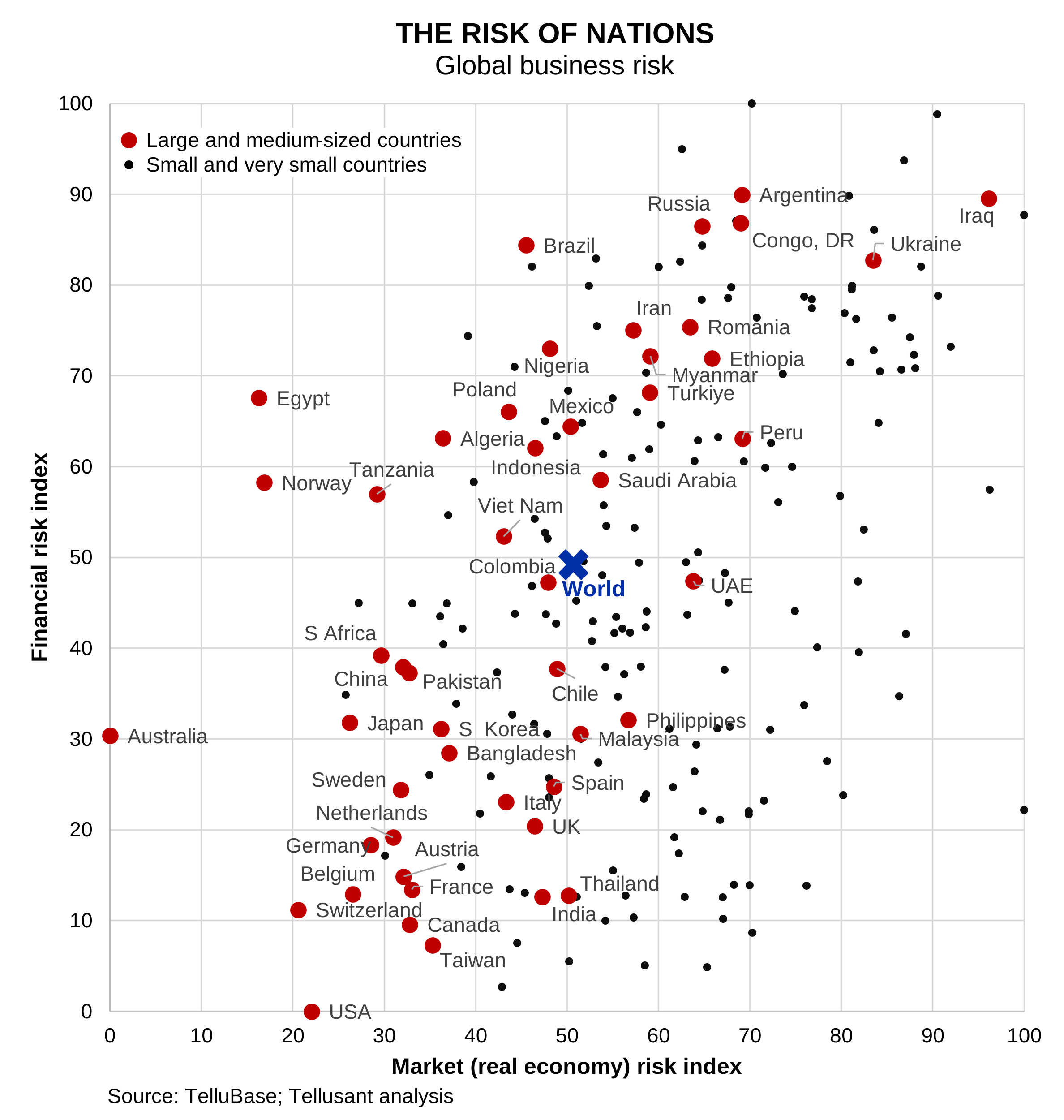
How volatile is the real economy behind demand?
How volatile are exchange rates and the financial environment?
Tellusant’s published country-risk method uses historical volatility in GDP, inflation, and exchange rates, with more weight given to recent years. Principal component analysis separates this information into market and financial risk dimensions.
The resulting comparison helps you see how countries differ on those two dimensions. A country can have a relatively stable real economy and a more volatile financial environment, or the reverse. The distinction matters when assessing a country’s economic stability.
Explore the public country-risk comparison · Read the published country-risk example
The country comparison measures historical economic volatility. A company interprets the results in relation to its own exposure to each market; country volatility alone does not establish the probability of a company loss or predict individual events.
Q-Risk also addresses company revenue and cost risk. Company and business-unit analysis requires a separate assessment; the country comparison above is one part of Q-Risk.
The country method: GDP, inflation and exchange-rate volatility, weighted toward recent years and separated into two dimensions using principal component analysis.
Why exchange-rate assumptions matter to a strategic plan, and how inflation differentials inform the long-term perspective.
An April 2025 analysis of tariff impacts, illustrating how a specific economic shock can be examined alongside historical volatility.
Tell us which markets or business units you want to assess and over what period. For company analysis, we will also discuss the available revenue and cost data.
 English English
 Español de México English English Español de México